How the rotor makes lift, the three controls (collective/cyclic/pedals), torque and anti-torque, dissymmetry of lift, translational lift, ground effect, autorotation and vortex ring state, plus gyroscopic precession, LTE, dynamic rollover, ground resonance, the blade aerodynamic vectors (pitch/AoA/inflow) and the power required curve.
An aeroplane drives a fixed wing forward to make lift. A helicopter does it differently — it "spins" its wing instead. Each rotor blade is an aerofoil that is moving through the air all the time, so it can make lift even while the aircraft hovers motionless.
10.1 The Three Controls
10.1 The controls
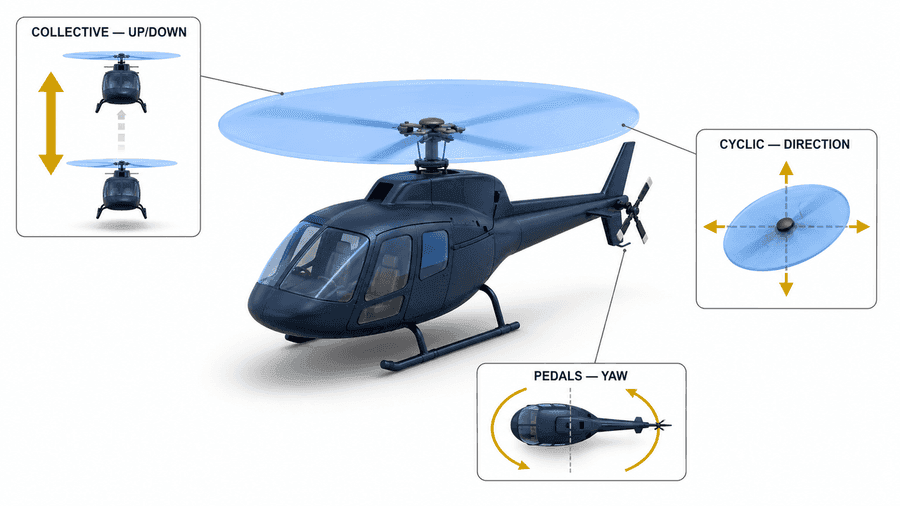
A helicopter is flown with three primary controls that always appear on the exam:
Collective (collective pitch lever): raise it = increase the pitch of all rotor blades together → total lift increases and the helicopter climbs.
Cyclic (cyclic stick): tilt the rotor disc in any direction and the lift tilts that way → the helicopter moves that way (fore/aft/sideways).
Anti-torque pedals: control the thrust of the tail rotor to counter torque and to steer the yaw.
Chapter summary
The heart of PPL(H) is to understand that the rotor is a spinning wing that makes lift, controlled by collective/cyclic/pedals, with torque countered by the tail rotor. Know dissymmetry of lift, retreating blade stall, translational lift, ground effect, the pitch/AoA/inflow relationship and blade washout, the three wind regions that cause LTE, the power required curve and Vy, and above all autorotation and vortex ring state, which can mean life or death.
Key terms
Collectiveคันรวมพิทช์
Changes the pitch of all blades together → controls total lift (up/down)
Cyclicคันบังคับวงรอบ
Tilts the rotor disc → controls the direction of movement
Anti-torque Pedalsคันเหยียบแก้แรงบิด
Control the tail rotor to counter torque and steer yaw
Dissymmetry of Liftความไม่สมมาตรของแรงยก
Advancing vs retreating blade make unequal lift in forward flight
Autorotationออโตโรเทชัน
Gliding down on a wind-driven rotor when the engine fails
AoA = pitch − inflow angle; washout = more pitch at the root, less at the tip
End-of-chapter quiz
20 questions
In short: Collective = up/down, Cyclic = which direction, Pedals = yaw the nose left/right.
10.2 Torque and Anti-torque
When the engine spins the main rotor one way, Newton's law means the fuselage of the helicopter tends to spin the opposite way (torque reaction). Most helicopters therefore have a tail rotor at the end of the tail that produces a sideways thrust to cancel this torque — and steers the yaw at the same time.
10.3 Dissymmetry of Lift
10.3 Dissymmetry
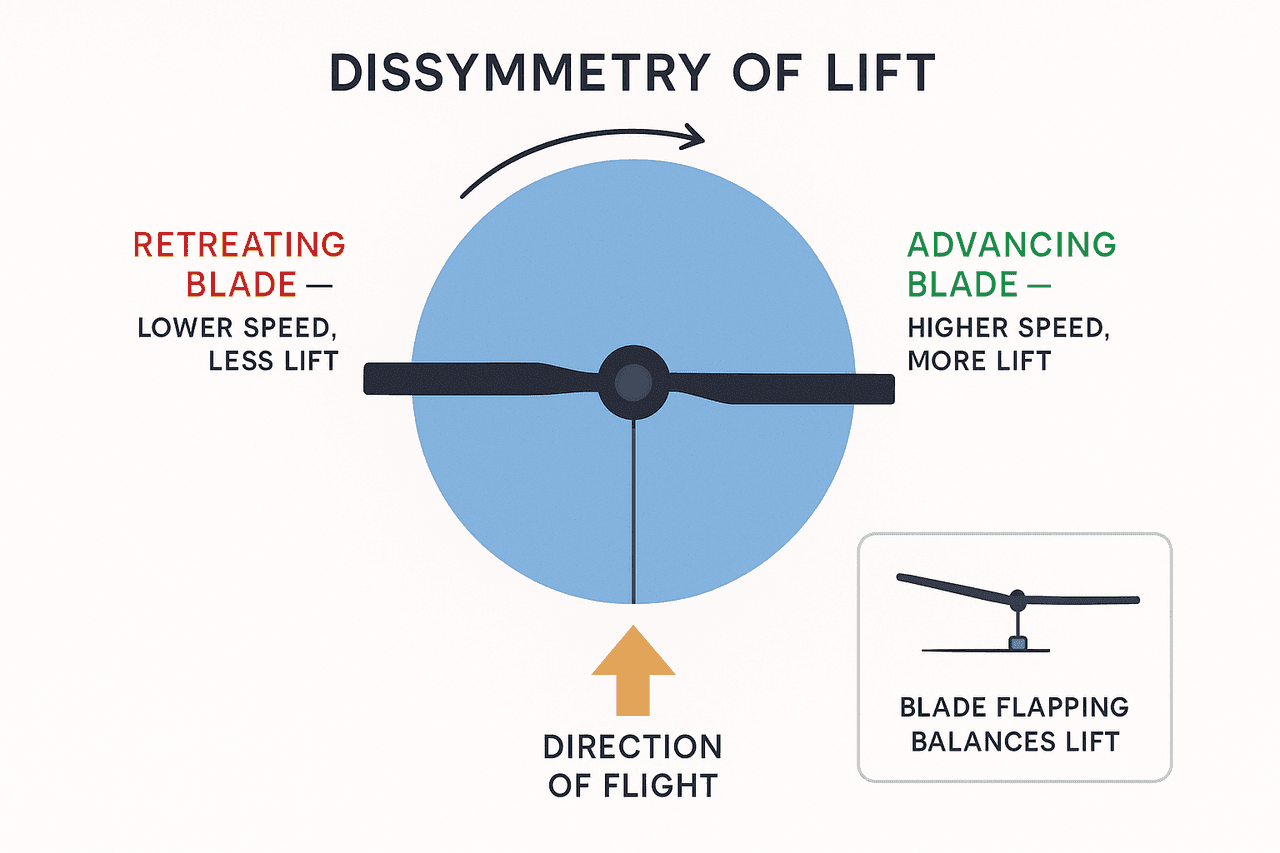
When a helicopter flies forward, the advancing blade meets the air at a higher relative airspeed than the retreating blade, so the lift on the two sides is unequal. Left uncorrected, the helicopter would roll. Nature solves it with blade flapping (the blades can rise and fall), which adjusts the angle of attack so that lift is balanced across the disc.
10.4 Translational Lift and Ground Effect
Translational lift: as the helicopter starts moving forward (around 16–24 kt), air flows through the rotor more efficiently, giving "free" extra lift called Effective Translational Lift (ETL).
Ground effect: hovering close to the ground (hover in ground effect, HIGE) needs less power than hovering high (out of ground effect, HOGE), because the ground supports the cushion of air.
10.5 Autorotation — Gliding Down When the Engine Fails
10.5 Autorotation
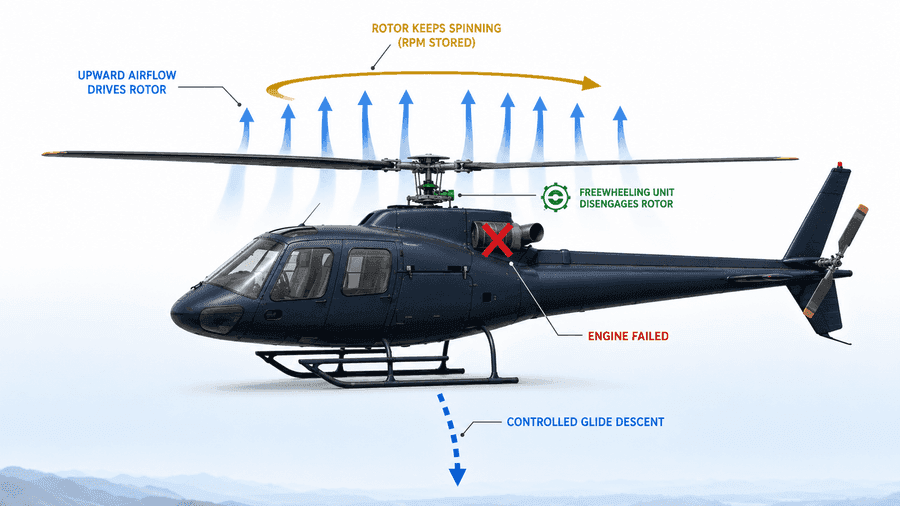
If the engine fails, the helicopter does not simply drop. The pilot immediately lowers the collective so that the airflow rising up through the rotor keeps it "spinning" (like a turbine), storing energy in rotor RPM. That energy is then used to "pull" collective near the ground to slow the descent and touch down gently. The mechanism that makes this possible is the freewheeling unit, which disconnects the rotor from the dead engine.
10.6 Vortex Ring State — The Slow-Descent Trap
10.6 Vortex Ring
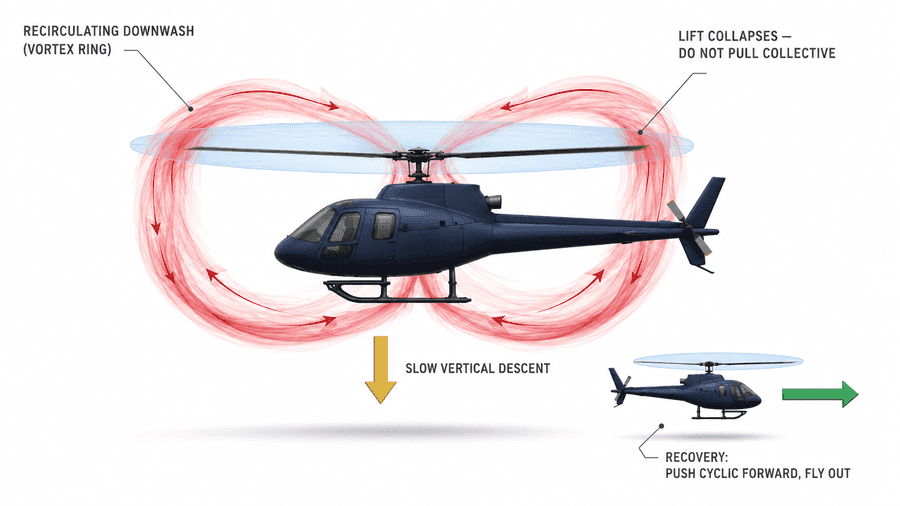
If a helicopter descends straight down at low speed while still applying power, it can "fall into its own downwash," forming swirling vortices around the blade tips (vortex ring state, or settling with power). Lift collapses rapidly even as you add more power. The fix is to push the cyclic forward to fly out of the disturbed air — not to add collective.
10.7 Gyroscopic Precession
A fast-spinning rotor behaves like a gyroscope — when a force is applied at one point, the effect shows up at the point 90 degrees further round in the direction of rotation. The control system is therefore designed to feed cyclic inputs 90 degrees ahead, so the rotor disc tilts in the direction the pilot actually wants.
Gyroscopic Precession — 90° Phase Lag
Gyroscopic precession is the phenomenon whereby a force applied to a spinning disc does not take effect at the point where it is applied, but instead takes effect at a point 90° further round in the direction of rotation (90° in the direction of rotation). For this reason the cyclic control system must be designed so that the input is fed in 90° before the point where you actually want the blade to rise or fall, so that the rotor disc tilts the way the pilot wants. Without compensating for this, the disc's response would be in the wrong direction relative to the control input. The helicopter designer calculates this phase lag in advance into the swashplate system, so the pilot flies normally without having to think about it in practice.
---
Translating Tendency
In the hover, the thrust the tail rotor generates to oppose the torque of the main rotor does not cancel out completely in the horizontal plane, so the helicopter tends to drift sideways in the same direction that the tail rotor pushes the aircraft (translating tendency). For helicopters whose main rotor turns anti-clockwise (seen from above) — such as American types like Bell/Robinson/Sikorsky (whereas European types like Airbus/Eurocopter turn the main rotor clockwise and everything is reversed) — the tail rotor pushes the aircraft to the right, so the aircraft drifts to the right. The pilot must compensate with a little lateral cyclic to the left to hold a stationary hover. A side effect is that the rotor disc tilts slightly, so the skid/wheel on the tilted side carries more weight — one of the factors that can lead to dynamic rollover.
---
LTE — Loss of Tail Rotor Effectiveness
LTE (Loss of Tail Rotor Effectiveness) is a condition in which the tail rotor suddenly loses its ability to oppose torque, usually at low airspeed, low altitude or while hovering. It happens when the wind comes from a direction that rapidly degrades tail rotor effectiveness. For helicopters whose main rotor turns anti-clockwise (seen from above) of the American type (Bell/Robinson/Sikorsky), the most dangerous wind direction is roughly 285°–315° (wind from the left rear). For European helicopters whose main rotor turns clockwise, the critical sector is a mirror image. This is because the wind blows straight into the tail rotor's vortex ring, so the anti-torque thrust disappears and the aircraft yaws rapidly. The recovery: reduce power immediately (reduce collective) and push the cyclic forward to gain airspeed out of the hover.
---
Dynamic Rollover
Dynamic rollover occurs when a helicopter is on the ground (not yet fully lifted off) and begins to pivot about a ground contact point (a wheel or one skid), the so-called ground contact point. If the roll angle exceeds ~10°, the lift that is still being produced turns into a force that pulls it over further instead of supporting it, so the helicopter rolls over. The single most important thing to avoid: do not apply lateral cyclic towards the ground contact point (for example, rolling right and then pushing the cyclic further right), because that accelerates the rollover. Prevention: always take off and land on level ground, reduce collective smoothly on landing, and beware of lateral cyclic on sloping ground or during a slope landing.
---
Ground Resonance
Ground resonance is a vibration/oscillation caused by coupling between the lead-lag motion of the rotor blades and the natural frequency of the undercarriage system (landing gear/skids). When the two frequencies enter resonance, the amplitude builds up rapidly and can destroy the structure in just a few seconds. Ground resonance can occur on touchdown, while rolling on the ground, or during rotor spin-up/spin-down. A lag damper on the rotor blades and the landing-gear design help prevent it, but if it does start there is only one choice: lift off immediately if you can, or shut down immediately to bring the rotor RPM out of the resonance range. Never sit and watch, because the structure will fail first.
---
Autorotation — Three Phases
Autorotation is an emergency landing without engine power (a power-off descent) that uses the energy of the airflow rising up through the rotor during the descent to maintain Nr (rotor RPM). It is divided into three main phases:
1. Entry (entering autorotation) When the engine fails, the pilot must lower the collective immediately to reduce the pitch of the rotor blades and prevent Nr from dropping too low. Then set the airspeed at the best autorotation glide speed, typically ~50–70 knots depending on the helicopter type. Nr must stay in the green arc as defined by the RFM.
2. Steady Descent In this phase Nr is constant, with the airflow rising up through the rotor blades (upward inflow) feeding energy into the rotor disc to keep it turning. The rate of descent is very high, typically ~1,500 ft/min, much higher than a fixed-wing aircraft because the drag of the rotor disc is large — but that also means there is energy stored in the rotor for use during the flare.
3. Flare + Landing Before reaching the ground, the pilot pulls the cyclic aft (flare) to reduce both the rate of descent and the airspeed; at the same time Nr increases due to inertia and pitch change. Close to the ground, the pilot raises/pulls up the collective (raise/pull up collective) to use the stored lift to reduce the sink rate one last time before touchdown. The timing must be very precise, because Nr drops rapidly after the collective pull.
Additional Topics for ECQB Coverage
Mast Bumping
Mast bumping is a hazard specific to semi-rigid teetering rotors (e.g. the Robinson R22/R44, Bell 206). It is caused by flying into a low-G condition by pushing the cyclic forward abruptly (a pushover), which unloads the rotor disc. At that moment the tail rotor keeps pushing sideways, so the fuselage rolls. A pilot who responds with lateral cyclic at once causes the blades to flap beyond their limit until the rotor hub strikes the mast, which can sever it in mid-air. The recovery is to gently pull the cyclic aft to restore G first; never correct the roll with cyclic during low-G.
Helicopter Stability
By nature a helicopter is far less stable than a fixed-wing aircraft, especially in the hover, where it has almost no static stability at all — when disturbed it keeps drifting instead of returning to its original state. The fuselage hangs below the rotor like a pendulum (pendulous fuselage), which makes it prone to swinging. Many helicopters therefore have aids such as a stabilizer bar (Bell), a horizontal stabilizer on the tail, or a SAS/autopilot to add damping. The pilot must control continuously because the aircraft will not return to its original state by itself.
Coning, Coriolis Effect and Lead-Lag
Coning is the upward bending of the rotor blades into a cone shape because lift overcomes the centrifugal force. The coning angle increases when weight, G force or pitch angle increase. As the blades bend up, the centre of mass of each blade moves closer to the axis of rotation; by the conservation of angular momentum the blade tends to accelerate forward — this is the Coriolis effect. An articulated rotor therefore has a lead-lag hinge (drag hinge) so the blade can move ahead/behind freely, together with a lag damper to prevent oscillation.
The H-V Diagram and the Rotor-Disc Regions in Autorotation
The Height-Velocity diagram (also called the dead man's curve) shows the height-speed areas that are "dangerous" because autorotation is hard if the engine fails — namely low height but low speed (e.g. a high hover) and high speed but very low height. During autorotation the rotor disc divides into three regions along the radius: the driven region (near the tip, producing drag), the driving/autorotative region (the middle, feeding energy to keep the rotor turning) and the stall region (near the root, where the angle of attack is too high and stalls).
Managing Tail Rotor Failure and Alternative Anti-torque Systems
If the tail rotor fails in forward flight, the fuselage yaws but the vertical fin still provides some weathercock effect; the pilot maintains speed and makes a run-on landing. A failure in the hover causes the fuselage to spin violently, and the option is to reduce collective and enter autorotation. Alternative anti-torque systems that appear on the exam include the Fenestron (a fan enclosed in the tail fin), NOTAR (using air blown from the fuselage with the Coandă principle), the tandem rotor (two rotors fore and aft turning in opposite directions) and the coaxial (two rotors on the same axis turning in opposite directions). Both tandem and coaxial need no tail rotor because the torques cancel each other out.
Rotor RPM (Nr) Limits — Low-Nr and High-Nr
Nr (rotor RPM) must always stay within the green arc defined by the RFM. If Nr is too low (low-Nr), centrifugal force decreases, the blades cone up sharply, lift falls and they stall easily. In a serious case Nr can decay beyond recovery (rotor decay), which is fatal — especially overpitching in thin air. If Nr is too high (high-Nr/overspeed), it puts stress on the blade and hub structure and can cause damage. The cure for low-Nr is to reduce collective and add power; for high-Nr, add collective to load the rotor.
Power Required vs Power Available, and the Effect of Density Altitude on the Hover Ceiling
The power required to hover depends on weight and air density, while the power available falls as the air thins. At high density altitude (hot, high, or low QNH) power available drops while power required increases, so the power margin narrows and the hover ceiling falls. The HOGE ceiling is always lower than the HIGE ceiling because HOGE needs more power. When DA is high enough, the helicopter may be able to hover only in ground effect, or only by relying on translational lift from moving forward.
The Aerodynamic Vectors of a Rotor Blade: Pitch Angle, Angle of Attack, Inflow Angle
A rotor blade is a spinning wing. The air the blade actually "feels" is the sum of two velocity vectors:
Rotational airflow: the air coming at the blade in the plane of rotation, because the blade turns around the hub (fast at the tip, slow at the root).
Induced flow / inflow: the air drawn down through the disc by the rotor.
Adding these two vectors gives the resultant relative airflow, which is tilted slightly downward from the plane of rotation. Then:
Pitch angle (blade pitch): the angle between the blade chord and the plane of rotation — this is the angle the pilot sets directly through the collective (and cyclic).
Inflow angle (induced angle): the angle between the plane of rotation and the resultant relative airflow — produced by the induced downflow; the greater the induced flow, the steeper the inflow angle.
Angle of attack (AoA): the angle between the blade chord and the resultant relative airflow — this is the angle that actually makes lift.
The key relationship to remember is AoA = Pitch angle − Inflow angle. In other words, the downward inflow always "eats up" part of the angle of attack, so adding collective (increasing pitch) does not increase AoA one-for-one, because the extra lift induces more inflow as well.
Blade twist / washout: the tip moves much faster than the root (rotational airspeed = radius × rate of rotation). If pitch were set equally along the whole blade, the tip would make too much lift and the root too little. Designers therefore twist the blade so the pitch is greater at the root than at the tip (washout), to spread lift evenly along the blade length, reduce bending loads at the tip, and make the lift distribution more efficient.
LTE — The Three Critical Wind Regions per the FAA
Many people wrongly think LTE comes from a single wind direction. In fact the FAA identifies three wind azimuth regions that cause LTE, each with a different mechanism (the directions below refer to an American helicopter whose main rotor turns anti-clockwise; for European helicopters that turn clockwise, the directions are mirror images).
Main rotor disc-vortex interference (~285°–315°): wind from the left/rear blows the main rotor tip vortices into the tail rotor, making the air entering the tail rotor turbulent, so its thrust fluctuates unevenly and the aircraft starts to yaw right unexpectedly.
Weathercock stability (~120°–240°): wind from behind (the tailwind sector) makes the fuselage try to turn its nose into wind (weathercock), like a wind vane. If the pilot does not counter it in time with pedal, the aircraft yaws faster and faster.
Tail rotor vortex ring state (~210°–330°): wind from the left (for a tail rotor that pushes to the right) blows straight into the plane of the tail rotor, putting the tail rotor into a vortex ring state of its own, so its thrust fluctuates and drops abruptly.
Note that these regions overlap and are different mechanisms — do not lump disc-vortex interference (which comes from the main rotor's vortices) together with tail rotor VRS (where the tail rotor itself enters a vortex ring). The recovery is the same for every region: reduce collective + push the cyclic forward to gain airspeed out of the hover, and counter the yaw firmly with pedal.
The Power Required Curve and Ground Effect, Quantified
The graph of power required versus airspeed is shaped like a "bucket" (a U-shape), because the power needed comes from components that change with speed in different ways:
Induced power: the power used to make lift, highest in the hover and falling as you fly faster (because translational lift makes the rotor work more efficiently).
Parasite power: the power to overcome the fuselage drag, increasing with the cube of speed, so it shoots up at high speed.
Profile power: the power to overcome the drag of the rotor blades themselves, fairly constant, rising slightly with speed.
Adding all three together, the graph has a lowest point — the "bottom of the bucket" — at a certain speed = Vy (best rate of climb speed) / minimum power speed, the speed that uses the least power in level flight and gives the best rate of climb because the power margin (the gap between power available and power required) is greatest there. The speed for the greatest range (best range) is a little higher than Vy (the point where a line from the origin is tangent to the curve).
Ground effect, quantified: the air cushion under the rotor near the ground clearly reduces induced power when within about one rotor diameter (~1 rotor diameter) above the ground. The effect is strongest below half a rotor diameter and gradually fades above one rotor diameter. This is why HIGE needs less power than HOGE, and why the HIGE ceiling is always higher than the HOGE ceiling.
ภาวะวงวนอากาศ
A slow vertical descent under power → loss of lift; fly forward to recover
Pitch Angleมุมพิทช์
The angle between the blade chord and the plane of rotation — set by the pilot via collective/cyclic
Angle of Attack (AoA)มุมปะทะ
The angle between the blade chord and the resultant relative airflow = pitch − inflow angle (makes the actual lift)
Inflow Angleมุมไหลเข้า
The angle the downward induced flow makes with the plane of rotation — the larger it is, the smaller the AoA
Blade Twist (Washout)การบิดใบ
More pitch at the root than the tip, to spread lift evenly (the tip travels faster)
LTEการสูญเสียประสิทธิภาพ tail rotor
Three FAA wind regions: disc-vortex ~285–315°, weathercock ~120–240°, TR-VRS ~210–330°
Power Required Curveกราฟกำลังที่ต้องใช้
Bucket-shaped (U) — the bottom = minimum power speed ≈ Vy, the best rate of climb
Ground Effectผลกระทบพื้นดิน
The air cushion reduces induced power within ~1 rotor diameter above the ground
Recover vortex ring state with cyclic forward, not more collective
This website is for educational use and initial exam preparation. Learners should verify against the official documents of their regulator and a flight instructor before real-world use. Content is based mainly on EASA standards; some figures and rules may differ from the Thai CAAT syllabus.
This is an independent educational project. It is not affiliated with, endorsed by, or connected to EASA, ICAO, CAAT, or any regulatory authority. Questions are either originally written or drawn from publicly available / openly licensed official sources (e.g. FAA public-domain material and Transport Canada's PSTAR question bank), attributed per question. They are not the live EASA or CAAT exam.