Communications
Standard phraseology and pronunciation, reading back important instructions, the overhead join procedure, and distinguishing a distress (MAYDAY) from an urgency (PAN-PAN).
This website is for educational use and initial exam preparation. Learners should verify against the official documents of their regulator and a flight instructor before real-world use. Content is based mainly on EASA standards; some figures and rules may differ from the Thai CAAT syllabus.
This is an independent educational project. It is not affiliated with, endorsed by, or connected to EASA, ICAO, CAAT, or any regulatory authority. Questions are either originally written or drawn from publicly available / openly licensed official sources (e.g. FAA public-domain material and Transport Canada's PSTAR question bank), attributed per question. They are not the live EASA or CAAT exam.
Aviation radio has a language all its own: short, clear, and unambiguous, because a single wrong word in the air can mean the difference between life and death. This chapter will teach you to speak it properly and to listen with precision.
9.1 Radio Phraseology and Pronunciation
Numbers in aviation radio are pronounced in a special way so they aren't confused amid background noise.
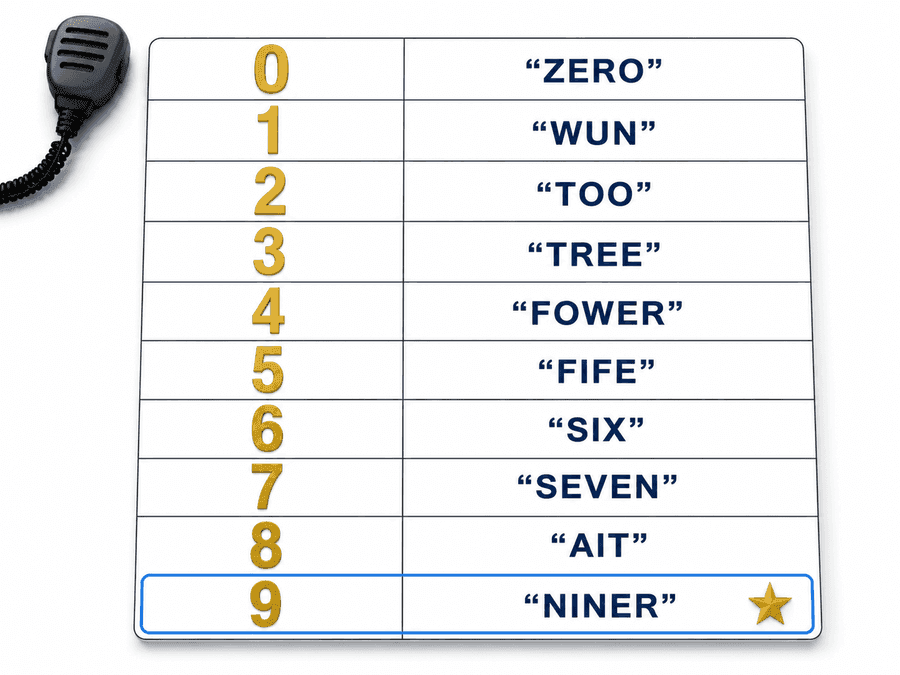
Commonly used standard words include ROGER (received), WILCO (will comply), AFFIRM and NEGATIVE (yes / no).
You must always read back important instructions, namely clearances, runways, frequencies, levels, and SSR codes.
9.2 Entering an Airfield by an Overhead Join
When the control tower instructs you to enter the airfield by the standard overhead join, there are five steps that appear often on the exam.
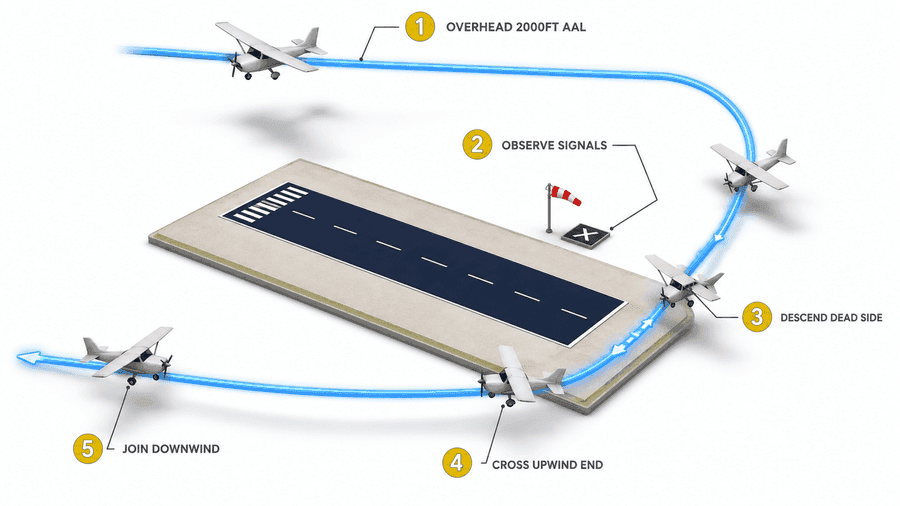
- Fly over the airfield at 2,000 feet above aerodrome level.
- Determine the circuit direction from the signal square, other traffic, or the windsock.
- Descend on the side with no traffic (the dead side) down to circuit height.
- Join the circuit by crossing the upwind end of the runway at circuit height.
- Take up the downwind position.
9.3 Emergency Messages
You must distinguish clearly:
- Distress uses the word MAYDAY, spoken three times, when there is a threat to life.
- Urgency uses the word PAN-PAN, spoken three times, when the situation is urgent but not yet life-threatening.
The first message should be transmitted on the frequency in use, stating your callsign, position, condition, and intentions.
Chapter summary
The core content is standard phraseology and pronunciation, reading back important instructions, the overhead join procedure, and distinguishing a distress (MAYDAY) from an urgency (PAN-PAN).
Key terms
The name used to call an aircraft or station.
Repeating an important instruction back to confirm it.
Grave danger requiring immediate assistance.
Urgent but not yet at the level of distress.
The standard procedure for joining an airfield circuit.
Frequently tested points
- MAYDAY = distress, PAN-PAN = urgency
- Distress always takes priority over Urgency
End-of-chapter quiz
8 questions