Operational Procedures
The sequence of actions in an emergency — fire, forced landing, ditching — and recognising the hazards of moving air such as wake turbulence, windshear, and microburst.
This website is for educational use and initial exam preparation. Learners should verify against the official documents of their regulator and a flight instructor before real-world use. Content is based mainly on EASA standards; some figures and rules may differ from the Thai CAAT syllabus.
This is an independent educational project. It is not affiliated with, endorsed by, or connected to EASA, ICAO, CAAT, or any regulatory authority. Questions are either originally written or drawn from publicly available / openly licensed official sources (e.g. FAA public-domain material and Transport Canada's PSTAR question bank), attributed per question. They are not the live EASA or CAAT exam.
The difference between the pilot who survives and the one who does not is sometimes measured in the first ten seconds. This chapter is therefore not about teaching you to fear emergencies, but about training your hands to act in the correct sequence before your mind has time to panic.
2.1 Fire and Forced Landing
- Carburettor fire during start: keep cranking to draw the flames back into the engine.
- Fire in the cockpit: cut off the fuel and electrics, use the fire extinguisher, and prepare to evacuate.
- Forced landing on the ground: choose the safest area and maintain the glide speed.
- Ditching (landing on water): declare the emergency, put on the life jacket, land along the line of the waves and wind, then evacuate quickly.
2.2 The Invisible Hazards: Wake Turbulence and Windshear
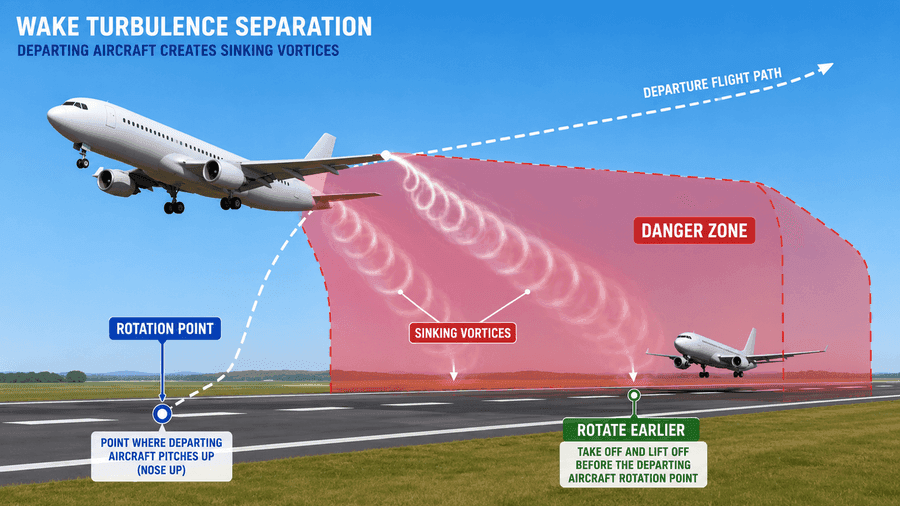
Wake turbulence is air that spins off the wingtips of the aircraft ahead. We cannot see it, but it carries enough force to flip a light aircraft. The greatest danger occurs when you are flying slowly, close to the ground, and behind a large aircraft.
Chapter summary
The heart of this chapter is memorising the sequence of actions in an emergency — fire, forced landing, ditching, and evacuation — together with recognising the hazards of moving air such as wake turbulence, windshear, and microburst.
Key terms
Spinning air (vortices) from the wingtips of the aircraft ahead.
A sudden change in wind direction or speed.
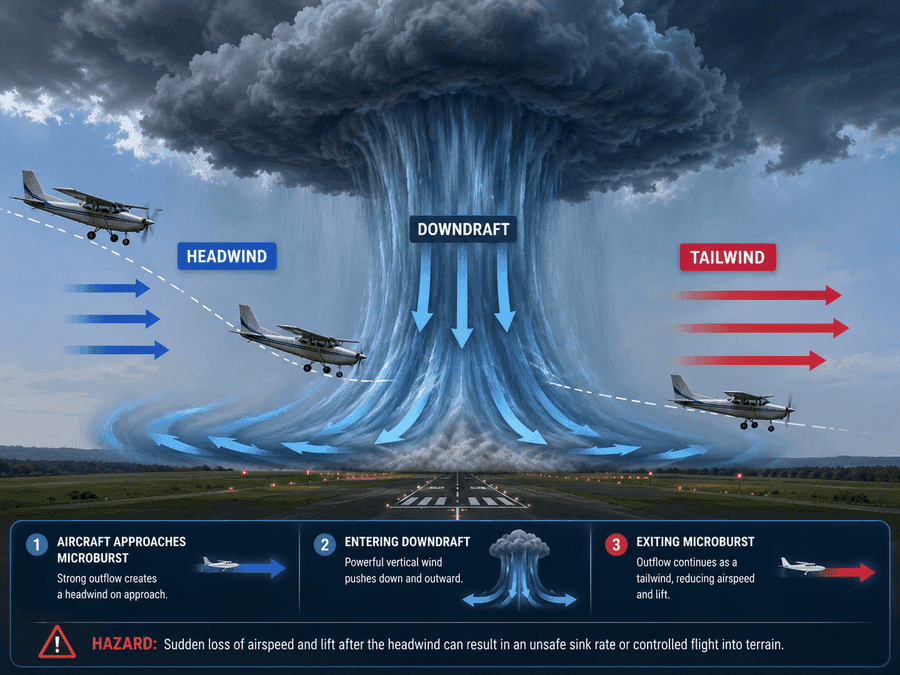
A violent, narrow downdraught of wind from a storm.
Bringing the aircraft down onto the surface of the water.
The speed that gives the greatest glide range and control when the engine has failed.
Frequently tested points
- Carburettor fire during start → keep cranking.
- Wake turbulence is most dangerous when flying slowly, close to the ground, behind a heavy aircraft.
End-of-chapter quiz
33 questions