Air Law
The traffic rules of the sky — right of way, lights and signals, airspace classes, VFR/IFR, documents to be carried on board, emergency codes, and the key PPL numbers.
This website is for educational use and initial exam preparation. Learners should verify against the official documents of their regulator and a flight instructor before real-world use. Content is based mainly on EASA standards; some figures and rules may differ from the Thai CAAT syllabus.
This is an independent educational project. It is not affiliated with, endorsed by, or connected to EASA, ICAO, CAAT, or any regulatory authority. Questions are either originally written or drawn from publicly available / openly licensed official sources (e.g. FAA public-domain material and Transport Canada's PSTAR question bank), attributed per question. They are not the live EASA or CAAT exam.
Imagine a road with no traffic rules at all: no red lights, no lane markings, everyone darting wherever they please. The result would be chaos. The sky is no different. The higher and faster you go, the more everyone needs a shared set of rules that all understand the same way. That is the heart of Air Law.
1.1 Who Must Give Way to Whom (Right of Way)
There are only a handful of right-of-way rules, but they appear in the exam almost every time. The simple guiding idea is: the harder an aircraft is to steer, the more priority it has. A balloon can barely be steered at all, so it has right of way over everything. A powered aeroplane, being the most manoeuvrable, must be the one to give way to others.
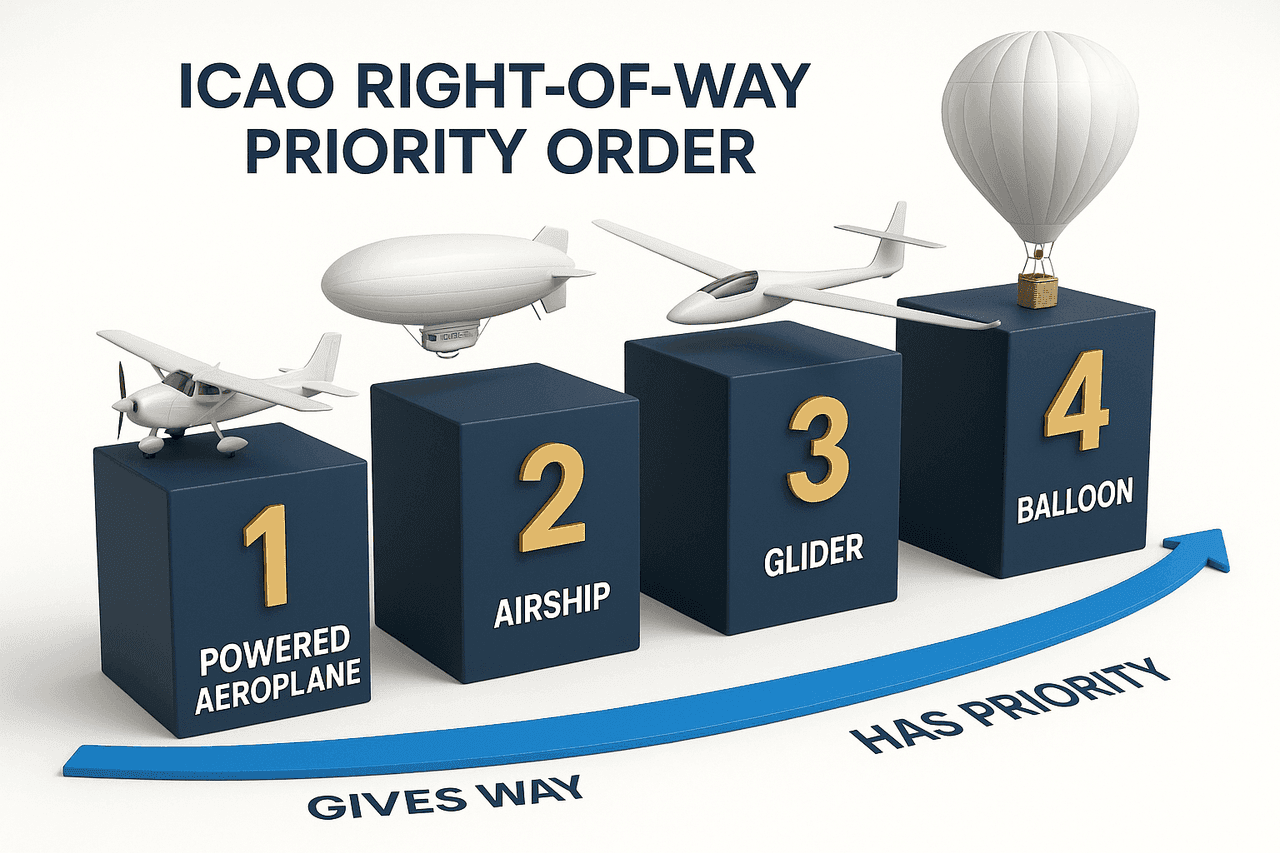
- Flying head-on: both aircraft turn right.
- Overtaking, both in the air and on the ground: pass on the right.
- An aircraft that is landing has priority over aircraft that are simply airborne.
1.2 Lights and Signals
When evening falls and the sky grows dark, aircraft can no longer see one another's shape. The only way to tell which direction another aircraft is facing is by its three Navigation Lights: a red light on the left wingtip, a green light on the right wingtip, and a white light at the tail.
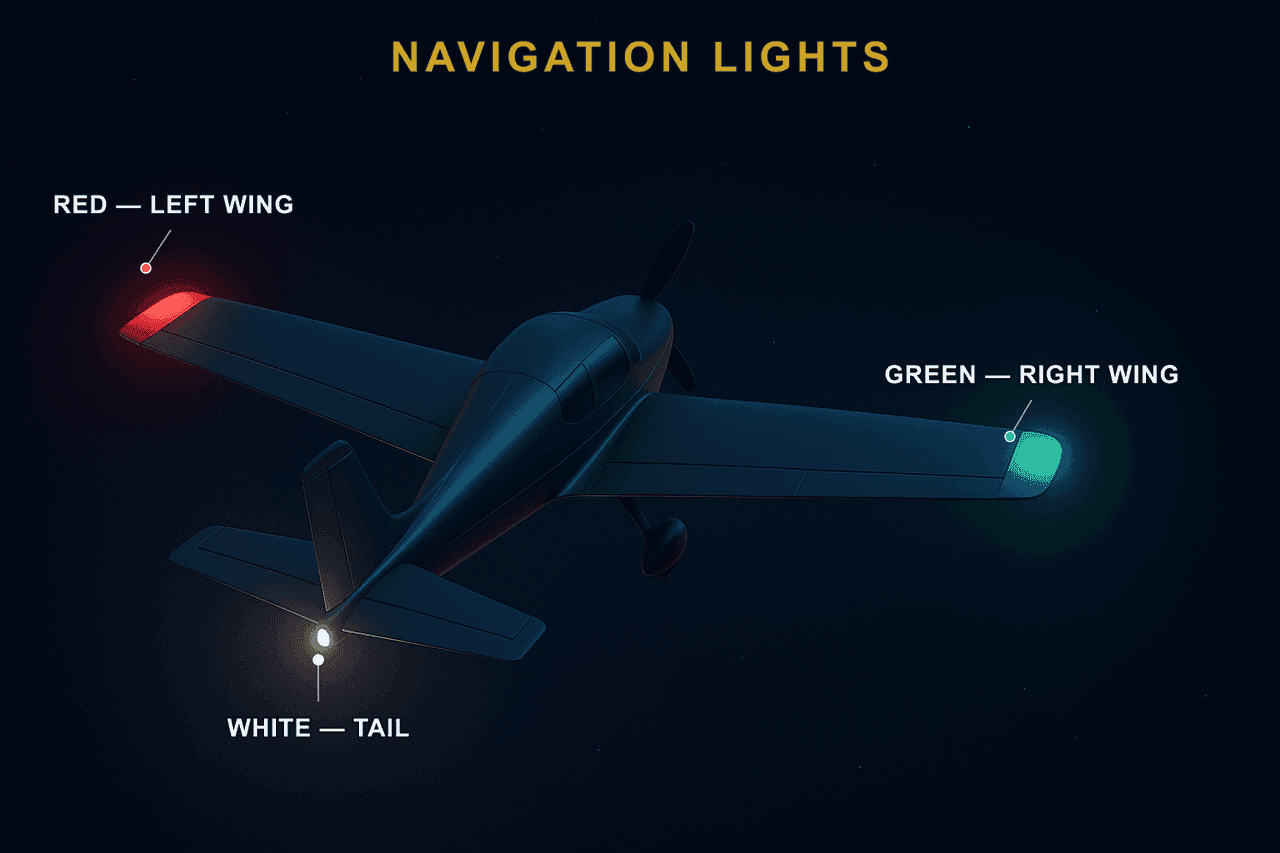
When the radio fails, the control tower uses a light gun to communicate instead. A steady green light means cleared, while a steady red light means stop or give way. Glide-path indicators such as PAPI and VASI tell you whether you are too high or too low on the approach.
1.3 Ground Hand Signals (Marshalling)
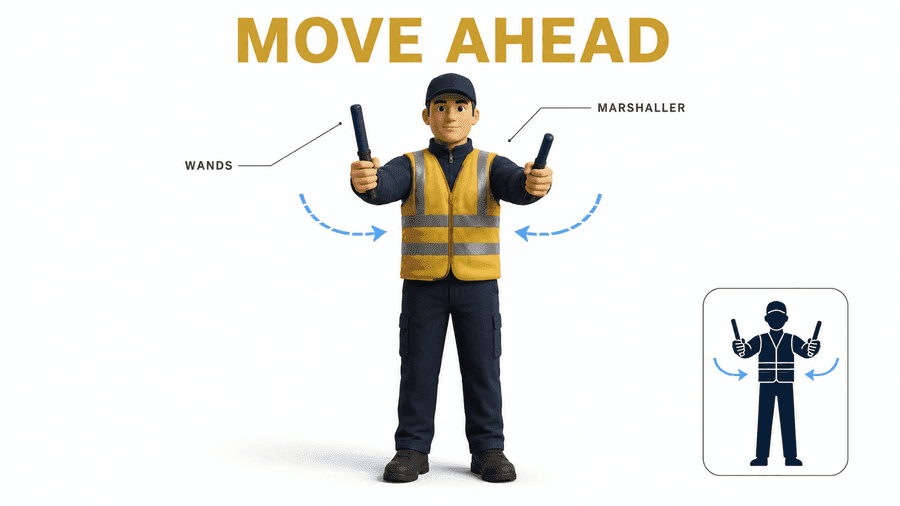
Before the wheels touch the runway, a ground marshaller waves signalling wands to guide the aircraft on the apron. A commonly examined gesture is arms extended and then bent at the elbows towards the body, which means move in towards me.
1.4 Airspace
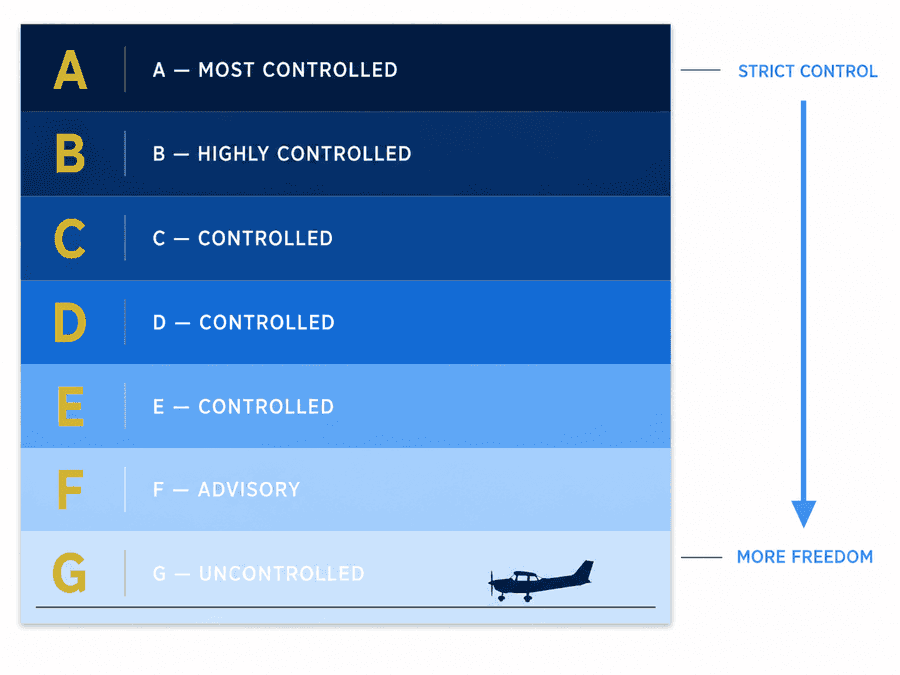
The sky is divided into classes from A to G. The earlier the letter, the more tightly controlled it is; the later the letter, the more freedom it allows.
- VFR (Visual Flight Rules) is flying by sight. It requires VMC weather conditions that meet the criteria for visibility and distance from cloud.
- IFR (Instrument Flight Rules) is flying by instruments, used when the weather is below the VMC criteria.
- Zones to watch out for: the Aerodrome Traffic Zone (ATZ), where you must call on the radio before entering; the Radio Mandatory Zone (RMZ), where a radio is required; and the Danger Area.
Air Traffic Services are divided into four types: Control, Flight Information, Advisory, and Alerting.
1.5 Documents, Law, and Emergencies
- Duties of the Commander: holds ultimate responsibility for safety and checks the documents and weight before flight.
- Article 5 of the Chicago Convention: the right of overflight and stopover for international aircraft.
- Documents that must be carried on board: the Certificate of Airworthiness (C of A), the registration, the pilot's licence, and insurance.
- The aim of an accident investigation is to prevent it from happening again, not to find someone to blame.
1.6 The PPL Licence — Numbers You Must Memorise
A PPL holder may fly privately but not for hire. The key threshold numbers under the EASA standard are as follows.
- Minimum flight hours: 45 hours in total, including at least 25 hours of dual instruction (with an instructor) and at least 10 hours of supervised solo.
- Of those, there must be at least 5 hours of solo cross-country, covering a distance of at least 150 nautical miles and landing at two aerodromes other than the home base.
- Minimum age: you may fly solo at 16, and hold the licence at 17.
The Medical Certificate counts its validity from the date of examination when newly issued or renewed; but if revalidated before it expires, the new period continues from the original expiry date. For night flying, you need a Night Rating, which requires an additional 5 hours in total, including 3 hours of dual instruction, 5 night take-offs and landings, and 1 night navigation flight over a distance of at least 50 kilometres.
1.7 Minimum Equipment and Aeronautical Information
The minimum equipment for VFR flight consists of four items: the Compass, a Timepiece, the Altimeter, and the Airspeed Indicator.
The Aeronautical Information Service (AIS) involves three terms you must tell apart:
- NOTAM — a notice announcing a temporary change or hazard.
- AIREP — a routine in-flight weather report, such as wind and temperature, usually sent automatically.
- PIREP — a pilot's report of hazardous weather, such as icing or turbulence.
Chapter summary
Air Law is like the traffic rules of the sky, focused mostly on memory: right of way, lights and signals, airspace classes, the difference between VFR and IFR, the documents carried on board, emergency codes, and the PPL threshold numbers. Once you have these memorised accurately, this chapter becomes an excellent source of marks.
Key terms
Aircraft that are in flight or moving on the manoeuvring area.
The rules for who must give way to whom.
Red on the left wing, green on the right wing, white at the tail.
Announces a temporary change or hazard.
Certificate of Airworthiness.
VFR uses visual reference in VMC, while IFR uses instruments.
Frequently tested points
- Head-on and overtaking — always turn right.
- Navigation lights: red on the left, green on the right, white at the tail.
End-of-chapter quiz
69 questions