HIGE vs HOGE, the U-shaped power-required curve, the effect of translational lift, the height-velocity diagram (dead man's curve), weight & balance and density altitude, plus Category A / OEI operations, slope landing, lateral CG effects, reading the performance charts, the WAT limit and hover ceiling, and retreating blade stall.
This subject is mostly about "power." A helicopter does not ask how far it can travel — it asks whether there is "enough power to lift off and hover" in the given conditions.
12.1 HIGE vs HOGE
12.1 HIGE/HOGE
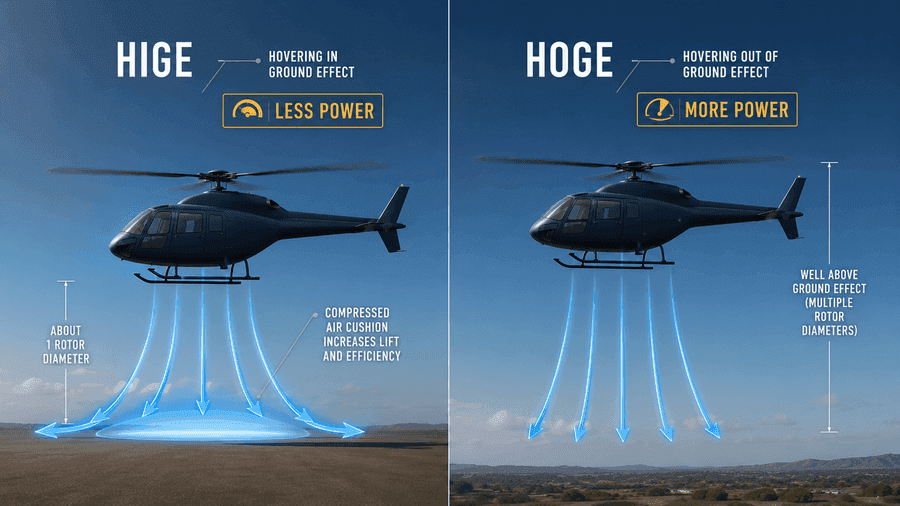
HIGE (Hover In Ground Effect): hovering near the ground (within about one rotor diameter) needs less power, because the ground supports the air cushion.
HOGE (Hover Out of Ground Effect): hovering high needs more power. A helicopter that can hover HIGE may not manage HOGE on the same day.
12.2 Power Required Curve
12.2 Power curve
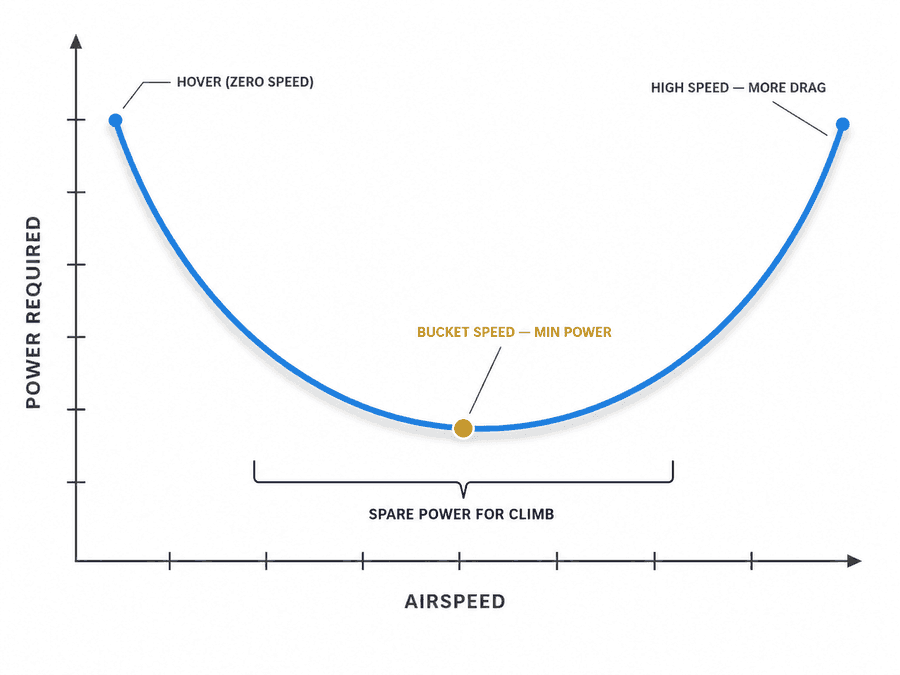
The graph of power required versus speed is a U-shape — high power in the hover (zero speed), falling as you start to move (gaining translational lift), lowest at the "bucket speed," then rising again at higher speed (more drag).
Chapter summary
The key points are the difference between HIGE and HOGE, the U-shaped power curve and the bucket speed, the height-velocity diagram that marks the danger zones, controlling CG on both axes, and how density altitude reduces power and lift together.
Key terms
HIGE / HOGEhover ใน/นอก ground effect
Hovering near the ground needs less power than high up
Power Required Curveกราฟกำลังที่ต้องใช้
U-shaped; lowest at the bucket speed
Height-Velocity Diagramแผนภาพความสูง-ความเร็ว
Danger zones if the engine fails (dead man's curve)
Density Altitudeความสูงตามความหนาแน่น
Hot/high/humid → low density → less lift and power
Overpitchingการเพิ่มพิทช์เกินกำลัง
Pulling collective until rotor RPM decays from lack of power
Performance Chart Reading
Frequently tested points
HIGE needs less power than HOGE
The power curve is U-shaped; the bottom = the bucket speed
End-of-chapter quiz
20 questions
12.3 Height-Velocity Diagram (Dead Man's Curve)
12.3 H-V diagram
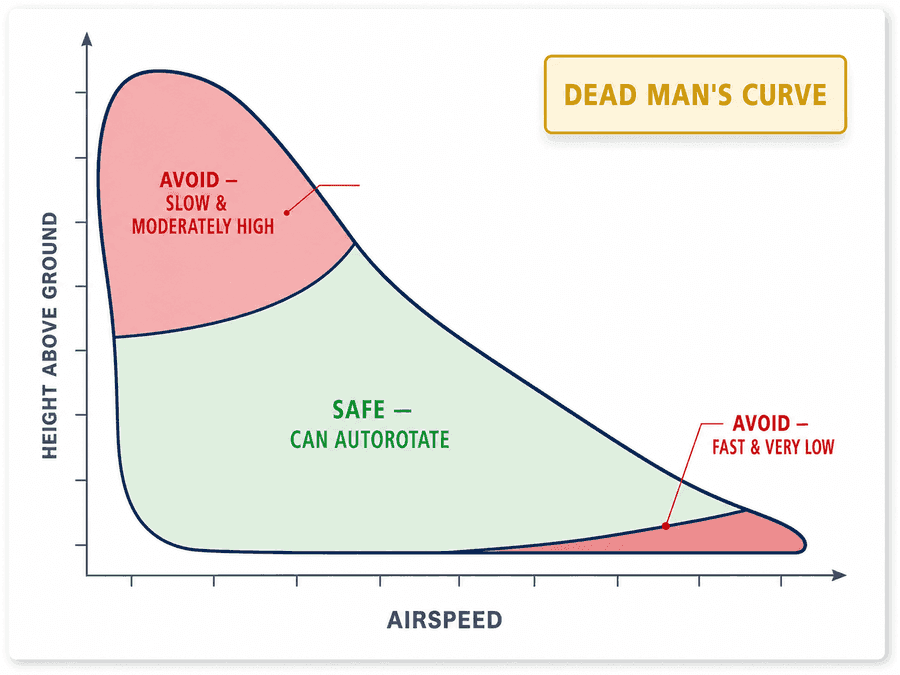
The height-velocity (H-V) diagram marks the zones of "height vs speed" that are dangerous if the engine fails, because there is not enough time/speed to enter autorotation in time. The main danger zones are slow and moderately high and very fast and very low — hence the nickname "dead man's curve."
12.4 Weight and Balance
As with aeroplanes, the centre of gravity (CG) must stay within limits — but a helicopter is more sensitive to CG position and must control both the longitudinal CG and the lateral CG, because a CG off to one side forces you to hold cyclic to that side, reducing the control margin remaining.
12.5 The Effect of Density Altitude
Hot, high and humid air is less dense (high density altitude) → the rotor "grabs" less air, so lift and engine power fall together.
12.6 Category A Operations
Category A flying is the highest standard of take-off/landing planning for multi-engine helicopters, requiring the aircraft to be able to handle OEI (One Engine Inoperative) throughout every phase of flight. The most important point in a Category A plan is the TDP (Take-off Decision Point), the point on the take-off path where the pilot must decide whether to "continue" or "abort" if one engine fails exactly there.
Before the TDP — engine failure before reaching the TDP: perform a Rejected Take-off (RTO), landing in the operating area (do not continue).
After the TDP — engine failure after passing the TDP: perform a Continued Take-off, climbing away on the single remaining engine.
---
12.7 OEI Performance
When one engine fails, the remaining engine must take the full 100% load, so the OEI hover ceiling drops significantly compared with AEO (All Engines Operative). The pilot must check whether the actual flying weight at that airfield is below the OEI hover ceiling; otherwise, even though it can take off on AEO, if the engine fails after the TDP it will not be able to maintain altitude on OEI.
Engine power in OEI mode is usually time-limited, e.g. OEI 2.5 min or OEI 30 min as the manufacturer specifies, and must not exceed the time allowed.
---
12.8 Slope Landing Technique
Landing on a slope (slope landing) has steps that must be done in order to prevent dynamic rollover, which happens very easily when one skid touches first and the cyclic is not handled carefully. The correct sequence is:
Approach the slope into wind for better control and to reduce tail rotor vortex interference.
Touch the upslope skid first — place the first contact point on the higher side.
Lower the collective slowly to transfer weight gradually onto the ground; never pull it down quickly.
Hold the lateral cyclic just right — do not tilt the cyclic too far towards the slope, because that tilts the rotor disc close to the ground on that side.
To depart — raise the downslope skid first, then lift vertically.
---
12.9 Lateral CG Effects in the Hover
A lateral CG offset from the centreline of the fuselage — for example when passengers sit on one side, or there is a load slung to one side — forces the pilot to hold lateral cyclic continuously to stay level. The result is that the control margin on that side is reduced, and if more cyclic is needed it may reach the stop. In addition, a large lateral CG offset increases the risk of dynamic rollover, because the rolling moment is reinforced by the already-offset weight.
12.10 Reading the Performance Charts — A Worked Example
The exam and real flying both require you to read the charts in the RFM (Rotorcraft Flight Manual). Most performance charts ask you to enter four values: Pressure Altitude + OAT (outside air temperature) + weight + wind, and then read out a value, e.g. the take-off / landing distance, or the maximum weight that can hover (HOGE/HIGE max weight).
Steps to read a take-off/landing distance chart (follow the line one grid at a time):
First find the pressure altitude (set the altimeter to 1013 hPa and read it, or calculate it from QNH) and enter it on the vertical axis at the left.
Draw a horizontal line to meet the OAT curve matching the actual temperature — this combines the effect of density altitude.
From the intersection, draw a line straight down to the next grid (reference line), then follow the guide line of the actual gross weight.
Then enter the wind grid — a headwind follows the line that makes the distance shorter; a tailwind makes the distance longer.
Read the distance out at the far right axis. Do not forget to multiply by the safety factor required by regulation.
12.11 The WAT Limit and the Hover Ceiling
WAT limit stands for Weight–Altitude–Temperature — a limit that tells you, at a given altitude and temperature, the maximum weight the aircraft can carry while still meeting the required performance (e.g. able to hover, or to climb at the minimum rate). As the air gets hotter or the airfield is higher (high density altitude), the WAT limit squeezes the maximum weight down.
The hover ceiling is the maximum altitude at which the aircraft can still hover at a given weight; there is both a HIGE ceiling (higher, because ground effect helps) and a HOGE ceiling (lower). The hover ceiling is found by entering the chart with the actual weight + temperature and reading the maximum altitude at which the power available still just equals the power required to hover.
12.12 Retreating Blade Stall and Dissymmetry of Lift at High Speed
In forward flight, the advancing blade has a high relative airspeed while the retreating blade has a low one, producing dissymmetry of lift (unequal lift left and right). The system corrects it with blade flapping (the advancing side flaps up to reduce angle of attack, the retreating side flaps down to increase it), but at high speed (VNE) the retreating side must increase its angle of attack so much that it stalls — called retreating blade stall, which is the top speed limit of a helicopter.
Symptoms: severe low-frequency vibration, a tendency to pitch up (nose pitch-up) and to roll towards the retreating blade side (roll). If allowed to develop, control is lost.
Recovery:reduce speed, lower collective (reduce total pitch), reduce the severity of the manoeuvre / G force, and reduce altitude/density altitude. Factors that bring it on sooner = high speed, heavy weight, high density altitude, low rotor RPM, and turning/turbulence.
Additional ECQB-Linked Topics
LDP (Landing Decision Point)
The LDP is the decision point on the «landing side», the counterpart to the TDP on the «take-off side» in a Category A plan. If One Engine Inoperative (OEI) occurs «before the LDP», the pilot still has enough power and space to perform a balked landing (go-around) and climb away on the single engine. But if OEI occurs «after the LDP», the pilot must continue to land on the FATO, because there is no longer enough power to go around.
Confined Area Operations
A confined area is a landing site surrounded by obstacles such as trees or buildings. The pilot must recce (assess) the wind direction, the area size and the obstacle points, and always plan an approach path and an escape path. The approach should be steeper than normal (a steep approach) and into wind, and power must be controlled carefully because a high rate of descent combined with low speed risks vortex ring state.
Effective Translational Lift (ETL)
As the helicopter starts moving forward, the rotor takes in more fresh, less disturbed air, so lift increases and the power required falls. The clear onset of this is called Effective Translational Lift (ETL), occurring around 16–24 kt in general. It can be felt as a slight vibration and a tendency to pitch up (from the transverse flow effect). Once past ETL, the aircraft climbs better without adding collective.
Vortex Ring State (Settling with Power)
Vortex ring state (VRS), or settling with power, occurs when a helicopter has «low speed», a «high rate of descent (over about 300 ft/min)» and «still has power applied» all at the same time, so the air swirls back up through the blade tips, lift is lost, and pulling more collective only makes it sink faster. The symptoms are severe vibration, sinking, and difficult control.
Autorotation Performance
In autorotation the pilot maintains Nr with the airflow passing up through the rotor from below. The best glide speed usually coincides with the bucket speed region of the power curve, while the speed for the minimum rate of descent (min RoD) is a little slower. A heavy weight raises both the optimum glide speed and the rate of descent, but the glide ratio (distance per height) does not change much. Before touchdown the flare is used to reduce both the speed and the rate of descent.
Estimating Density Altitude and the Take-off Run
Density altitude is estimated roughly from pressure altitude plus the effect of temperature, using the rule of thumb that density altitude increases by about 120 ft for every 1°C above ISA at that level (pressure altitude is found by setting the altimeter to 1013 hPa). As density altitude rises, engine power and lift fall, so a longer ground run is needed before reaching ETL; likewise a heavier weight increases the take-off run and reduces the rate of climb.
การอ่านกราฟสมรรถนะ
Enter the chart in the order Altitude→Temp→Weight→Wind, then read the distance / max weight
WAT Limitขีดจำกัด Weight-Altitude-Temperature
Hot air / high airfield squeezes the maximum allowed weight down
Hover Ceilingเพดาน hover
The maximum altitude at which you can still hover at that weight (HIGE ceiling > HOGE ceiling)
Retreating Blade Stallใบกวาดถอยหลังสตอล
The high-speed limit; symptoms: vibration + pitch-up + roll; fix by reducing speed/collective
Dissymmetry of Liftแรงยกไม่สมมาตร
The advancing blade is faster than the retreating one; corrected by blade flapping
Transverse Flow Effectผลการไหลตามขวาง
At low speed (the ETL range) lift differs front-to-back, causing vibration and roll
Effective Translational Liftแรงยกจากการเคลื่อนที่
Around 16–24 kt, lift increases and the power required falls
Stay out of the H-V diagram zones so you can always autorotate
Control CG both longitudinally and laterally
High density altitude (hot/high) → watch for overpitching and rotor RPM decay
This website is for educational use and initial exam preparation. Learners should verify against the official documents of their regulator and a flight instructor before real-world use. Content is based mainly on EASA standards; some figures and rules may differ from the Thai CAAT syllabus.
This is an independent educational project. It is not affiliated with, endorsed by, or connected to EASA, ICAO, CAAT, or any regulatory authority. Questions are either originally written or drawn from publicly available / openly licensed official sources (e.g. FAA public-domain material and Transport Canada's PSTAR question bank), attributed per question. They are not the live EASA or CAAT exam.