Rotor system types, the swashplate, the transmission and freewheeling unit, tail rotor types, rotor RPM control and the mast bumping hazard, plus the governor/correlator, the Coriolis/lead-lag and Delta-3 hinge, the chip detector, hydraulic flight controls, and the fuel, electrical and engine/clutch systems.
A good helicopter pilot need not be an engineer, but must understand how each part works — because when a system signals trouble, you must read it and decide in time.
11.1 Main Rotor Systems
Three rotor systems appear on the exam:
Fully articulated: each blade can move three ways — flap (up/down), lead/lag (fore/aft) and feather (change of pitch). Usually used on helicopters with three or more blades.
Semi-rigid: two blades joined as a "see-saw" that can teeter; found on popular light helicopters (e.g. the Robinson family).
Rigid: blades fixed with no flap/lag hinges, relying on the flexibility of the material instead.
11.2 The Swashplate — Translating Commands to a Spinning Rotor
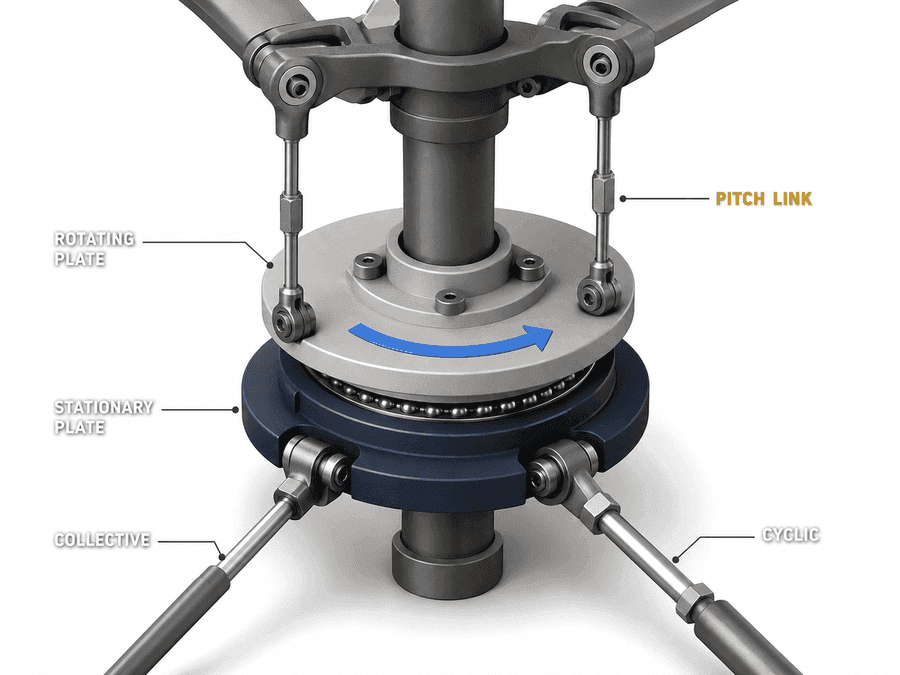
11.2 Swashplate
The heart that carries commands from the controls (which are stationary) to the rotor blades (which spin) is the swashplate, which has two parts:
a lower plate that is stationary, receiving the collective and cyclic inputs;
an upper plate that rotates with the rotor, passing the commands through pitch links to twist the pitch of each blade.
11.3 Transmission and the Freewheeling Unit
Chapter summary
The key points are the rotor system types (articulated/semi-rigid/rigid), the swashplate that translates commands to the spinning blades, the transmission and freewheeling unit that make autorotation possible, the tail rotor types and rotor RPM control, plus the mast bumping hazard on semi-rigid systems.
Key terms
Swashplateจานสวอช
Translates stationary control inputs to the spinning rotor blades
Freewheeling Unitคลัตช์ทางเดียว
Disconnects the rotor from a dead engine → enables autorotation
Tail Rotorโรเตอร์หาง
Counters torque and steers yaw (Fenestron/NOTAR are alternatives)
Different ways of mounting blades; affects handling
Mast Bumpingการฟาดเสากระโดง
A low-G hazard on semi-rigid (teetering) rotor systems
Hydraulic Servo Actuator
Frequently tested points
Swashplate: the lower plate is stationary, the upper plate rotates with the rotor
The freewheeling unit is what makes autorotation possible
End-of-chapter quiz
20 questions
Helicopter General Knowledge · THAI PPL
11.3 Transmission
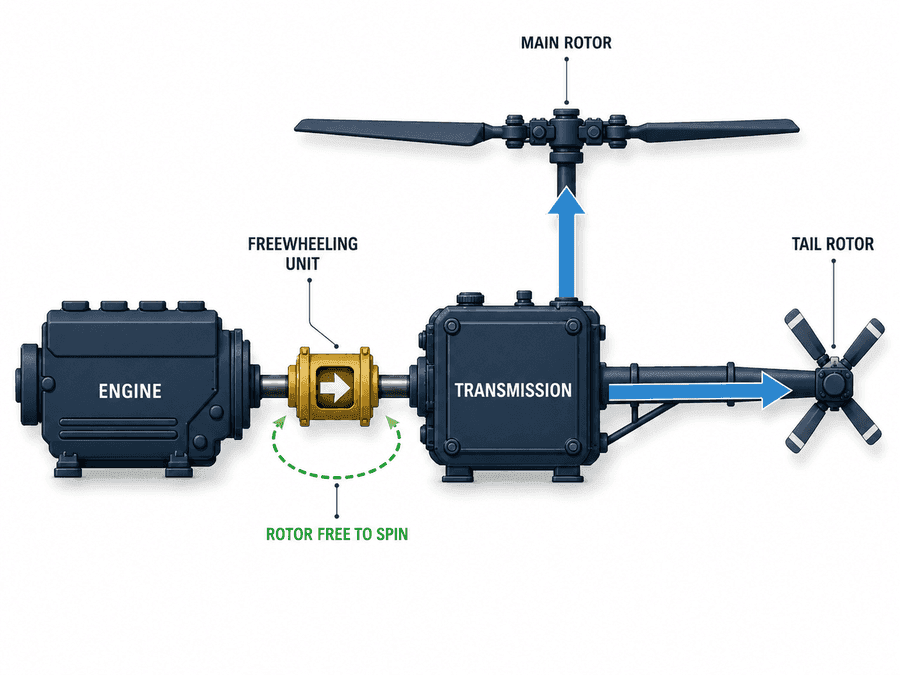
The engine drives both the main rotor and the tail rotor through the transmission/gearbox. The single most safety-critical part is the freewheeling unit (a one-way clutch), which automatically disconnects the rotor from the engine when the engine fails or slows below rotor speed, letting the rotor keep spinning freely — this is what makes autorotation possible.
11.4 Tail Rotor and Alternatives
11.4 Tail Rotor
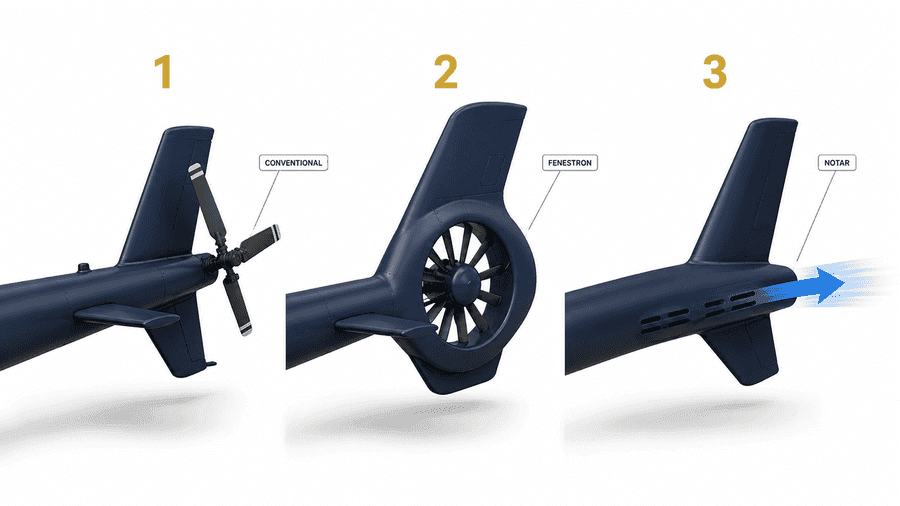
Conventional tail rotor: a small propeller at the end of the tail.
Fenestron: a fan enclosed in the tail fin — safer and quieter.
NOTAR (No Tail Rotor): a fan pressurises air into the tail boom; the air exits through longitudinal slots along the boom, creating the Coandă effect (circulation control) so the main-rotor downwash flowing over the boom produces a side force — supplemented by a direct jet thruster at the tail end for direct yaw control.
11.5 Rotor RPM Control and Mast Bumping
Rotor RPM must always stay within limits. Turbine engines usually have a governor that controls it automatically; piston engines use a correlator/governor to help.
Governor and Correlator
A governor is an electronic or mechanical system that continuously measures rotor speed (Nr) and automatically adjusts fuel flow or throttle to keep Nr constant at the set value, whatever the pilot does with the collective. The result is that Nr does not "drift" out of the safe range, and the pilot does not have to keep twisting the throttle by hand.
A correlator is a mechanical system that links the collective lever directly to the throttle in a coarse way (a coarse linkage). When the pilot raises the collective, the correlator increases the throttle proportionally at the same time, helping to reduce the droop (Nr sag) of the rotor before the governor has time to react. But the correlator cannot hold Nr as precisely as a governor, so the two systems are usually used together.
---
Coriolis Effect and Lead-Lag Motion
When a rotor blade flaps up (the tip moves closer to the axis of rotation), its radius of mass decreases, and by the conservation of angular momentum the blade accelerates about the vertical axis, so it leads (runs ahead of its normal position). Conversely, when the blade flaps down (the tip moves further from the axis), its radius of mass increases and the blade lags (falls behind its normal position). This phenomenon is the Coriolis effect in the rotating system of the rotor head.
The lead-lag forces build up and produce high stress at the blade root if the rotor head has no freedom to move in the horizontal plane. A fully-articulated rotor head therefore has a lead-lag hinge (drag hinge) together with a lead-lag damper to absorb the energy and prevent the oscillation known as ground resonance.
---
Delta-3 Hinge (Pitch-Flap Coupling)
A Delta-3 hinge is a flapping-hinge design that is not truly perpendicular to the rotor axis, but is inclined at the delta-3 (δ₃) angle. The result is that when the blade flaps up or down, the blade pitch changes automatically as a consequence (pitch-flap coupling). Typically, flapping up reduces pitch, which reduces lift somewhat, helping to limit excessive flapping.
The main benefits of Delta-3 are reduced blade loads at the root in asymmetric flight, reduced feedback forces transmitted back to the pilot's hand through the control system, and greater rotor stability without high mechanical complexity. Delta-3 is common on the tail rotor and on hingeless/bearingless rotors that need to reduce control loads.
---
Chip Detector
A chip detector is a permanent magnet installed at the lowest point of the transmission, a gearbox, or the tail rotor gearbox to catch metal particles (metal debris) that come loose into the lubricating oil. When enough metal debris accumulates to complete the electrical circuit on the chip detector, it triggers the chip warning light on the instrument panel.
A lit chip warning light means a part inside the gearbox is wearing abnormally or breaking up and that there is metal debris in the oil system — a serious early warning before a catastrophic gearbox failure. The correct procedure is therefore to land as soon as possible (land as soon as it can be done safely).
Additional Topics for ECQB Coverage
Instruments and Warning Systems
The helicopter instrument panel has key instruments that appear on the exam. Central is the «dual-needle tachometer» that shows two superimposed needles: engine RPM (Ne) and rotor RPM (Nr). In normal flight the two needles are «married» (overlaid), but when the engine fails and the freewheeling unit disengages, the needles «split» — the engine needle drops below the rotor needle, which confirms entry into autorotation. There are also a torque gauge, EGT/TOT, oil pressure and oil temperature, plus a caution/warning light panel.
Vibration Diagnosis
The frequency of a vibration tells you its source. A low-frequency «1 per rev» vibration (once per main rotor revolution) usually comes from a main rotor blade out of balance or out of track. A «2 per rev» vibration is common on two-bladed semi-rigid (teetering) systems and is somewhat normal, but indicates a problem if it grows severe. A high-frequency «N per rev» (medium/high frequency) vibration usually comes from the tail rotor or the drive train, e.g. a tail blade out of balance or a worn bearing.
Tail Rotor Drive Train
Power to the tail rotor does not come directly from the engine; it is taken from the main transmission out through the «tail rotor drive shaft», which runs along the tail boom, through an «intermediate gearbox» (if fitted) that turns the angle up the fin, and into the «tail rotor gearbox» at the end of the tail to turn the tail blades. Because the tail rotor is connected to the main drive system, it keeps turning during autorotation. The pilot controls the tail thrust through the «pedals», which change the (collective) pitch of the tail blades via the pitch change mechanism — the pedals do not change the RPM, they change the pitch to adjust thrust.
The Ground Resonance Mechanism and the Role of the Lead-Lag Damper
«Ground resonance» is a dangerous resonance that occurs on the ground when the blades of a fully-articulated rotor move in lead-lag in an unbalanced way, displacing the centre of gravity of the rotor disc off-centre. If the frequency of this oscillation matches the natural frequency of the landing gear (undercarriage/oleo), the energy builds up and grows rapidly until the helicopter is destroyed within seconds. The «lead-lag damper» on the rotor head absorbs the energy of this oscillation. Semi-rigid (teetering) systems have no lead-lag hinge and so do not suffer ground resonance. If it begins and the rotor RPM is sufficient, add collective and lift off the ground immediately.
Droop Stops and Flap Restraints
«Droop stops» are mechanical stops that prevent the rotor blades from flapping down (flap down) too far when the rotor RPM is low or stopped — for example during start-up, shutdown, or in a gust. Without droop stops, a sagging blade could droop low enough to «boom strike» (the blade striking the tail boom or fuselage). As the rotor RPM increases, centrifugal force tensions the blades and the droop stops release by themselves. Their counterpart is the «flap (anti-flap) restraints» that limit upward flapping at low RPM. Checking the droop stops is a pre-flight item that appears on the exam.
Transmission Torque and Oil Temperature Limits
The «transmission torque limit» may be lower than the power the engine can produce, especially on cold, high-pressure days when the engine is strong. The torque gauge (often read as a %) is therefore the power limit the pilot must watch. Never pull the collective until torque exceeds the limit even if the engine still has power to spare, because that will damage the gears and shafts. The «transmission oil temperature/pressure» indicates the health of the gearbox; an abnormally high temperature or a pressure drop means a lubrication failure and heat build-up, which can lead to a transmission failure.
11.6 Hydraulic / Powered Flight Controls
On medium and larger helicopters, the feedback (control loads) from rotor blades carrying enormous aerodynamic loads is too great for the pilot to overcome with muscle. A hydraulic system is therefore needed to boost the force, similar to power steering in a car.
The heart of the system is the servo actuator (hydraulic servo) between the controls and the swashplate. When the pilot moves the cyclic/collective even slightly, a valve in the servo releases high-pressure hydraulic fluid (often around 1,000–3,000 psi from a transmission-driven pump) to drive a piston that actually moves the swashplate, so the pilot exerts very little force.
When the hydraulics fail (hydraulic failure): the pilot feels the controls suddenly become heavy and there may be control feedback (stiff/heavy controls) through the hands. Some aircraft are designed to fly on in manual reversion (control by human force alone), but speed and load must be reduced because the forces required are very high and the aircraft is sensitive to jerks. The RFM recovery procedure usually calls for reducing speed, landing soon and avoiding abrupt control inputs. Some aircraft have dual hydraulic systems for redundancy.
11.7 Fuel and Electrical Systems
Fuel system: fuel is stored in fuel tanks, often placed low below/behind the cabin to control the centre of gravity. Piston engines use AVGAS (e.g. 100LL, dyed blue), while turbine (turboshaft) engines use Jet A-1 (kerosene) — absolutely never mix the types. Fuel management includes the tank selector, using the boost pump (an electric fuel pressure pump) to prevent vapour lock and supply pressure to the engine, and draining water/sediment (fuel drain/sump) before every flight. Always monitor fuel quantity and fuel pressure.
Electrical system: the heart is the battery for starting and standby power, plus an engine-driven generating device — either a generator (direct current, DC) or an alternator (which generates AC and then rectifies it to DC) — that supplies all systems and charges the battery in flight. The system has a bus bar to distribute power, an ammeter/voltmeter to monitor, and circuit breakers to protect against overcurrent.
11.8 Engine Types and Clutch
Helicopters use two main engine families:
Piston: cheap, runs on AVGAS, suited to small trainers, but with a lower power-to-weight ratio and a sharp loss of power at high density altitude.
Turboshaft turbine: converts the energy of hot gas into shaft power that drives the rotor through a free/power turbine; high power-to-weight, light, copes with altitude better, but expensive and thirsty at low power. Usually has a governor to control RPM automatically.
Engagement clutch (piston engines only): a piston engine must start and idle to warm up first, so it needs a clutch to gradually connect power to the still-stationary rotor (rotor engagement). The Robinson family uses a belt drive — an electric motor pulls a pulley to tension the belts gradually, slowly transmitting power until the rotor RPM catches up with the engine. Power then passes through the sprag clutch / freewheeling unit (one-way clutch) built into the drive system.
เซอร์โวไฮดรอลิก
Boosts control force and isolates rotor feedback from the pilot's hand
Hydraulic Failureไฮดรอลิกขัดข้อง
Controls suddenly heavy + feedback → reduce speed/load, manual reversion
Boost Pumpปั๊มดันเชื้อเพลิง
Electric pump supplying fuel pressure, preventing vapour lock
Engine-driven, supplies power and charges the battery; the alternator works well at low RPM
Turboshaft Engineเครื่องกังหันเพลา
High power-to-weight, light, copes with altitude; uses Jet A-1 and a governor
Engagement Clutch (Belt Drive)คลัตช์ต่อโรเตอร์
E.g. the Robinson belt drive — gradually engages the rotor at start (different from the freewheeling unit)
Tail rotor has 3 types: conventional / Fenestron / NOTAR
Semi-rigid (Robinson) risks mast bumping at low-G — never pushover
Turbines use a governor to control rotor RPM automatically
This website is for educational use and initial exam preparation. Learners should verify against the official documents of their regulator and a flight instructor before real-world use. Content is based mainly on EASA standards; some figures and rules may differ from the Thai CAAT syllabus.
This is an independent educational project. It is not affiliated with, endorsed by, or connected to EASA, ICAO, CAAT, or any regulatory authority. Questions are either originally written or drawn from publicly available / openly licensed official sources (e.g. FAA public-domain material and Transport Canada's PSTAR question bank), attributed per question. They are not the live EASA or CAAT exam.