Flight Performance & Planning
The correction factors for take-off and landing distances, keeping the Centre of Gravity (CG) within limits, and filling in the flight plan field by field.
This website is for educational use and initial exam preparation. Learners should verify against the official documents of their regulator and a flight instructor before real-world use. Content is based mainly on EASA standards; some figures and rules may differ from the Thai CAAT syllabus.
This is an independent educational project. It is not affiliated with, endorsed by, or connected to EASA, ICAO, CAAT, or any regulatory authority. Questions are either originally written or drawn from publicly available / openly licensed official sources (e.g. FAA public-domain material and Transport Canada's PSTAR question bank), attributed per question. They are not the live EASA or CAAT exam.
This is a chapter of numbers, but do not worry — most of it is simply multiplying figures against a table. Just memorise the factors precisely, and you will answer faster than anyone.
6.1 Factors That Increase Take-off and Landing Distance
The following table is the most frequently examined material in this chapter. Just memorise the correction factors, and every problem becomes simple multiplication.
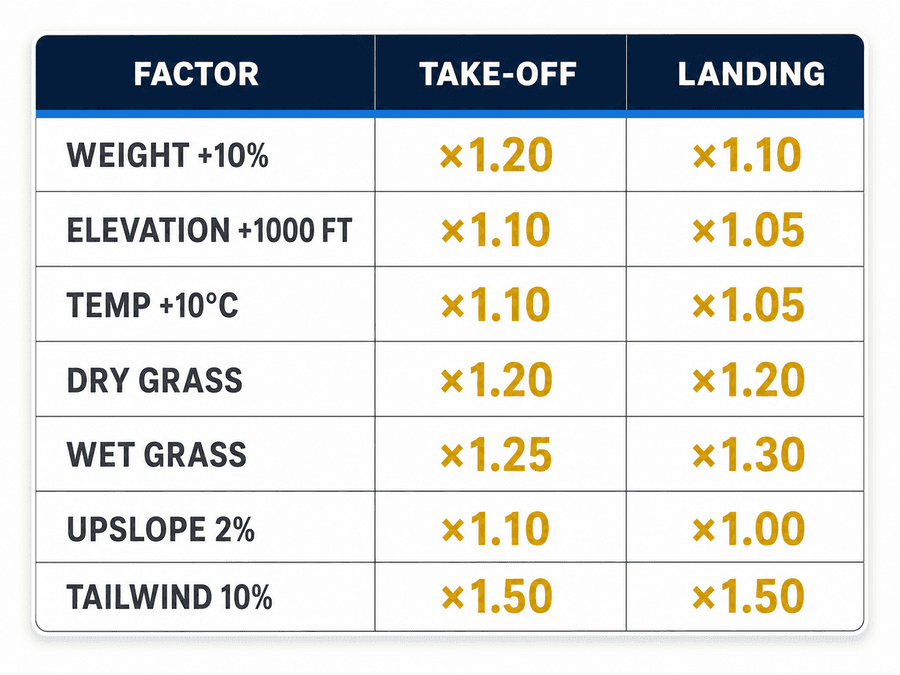
| Factor | Take-off | Landing |
|---|---|---|
| Weight increase of 10% | ×1.2 | ×1.1 |
| Airfield 1,000 ft higher | ×1.1 | ×1.05 |
| Temperature 10°C higher | ×1.1 | ×1.05 |
| Dry grass up to 20 cm | ×1.2 | ×1.15 |
| Wet grass | ×1.3 | ×1.35 |
| 2% upslope / downslope | ×1.1 | ×1.1 |
| Tailwind | ×1.2 | ×1.2 |
6.2 Weight & Balance
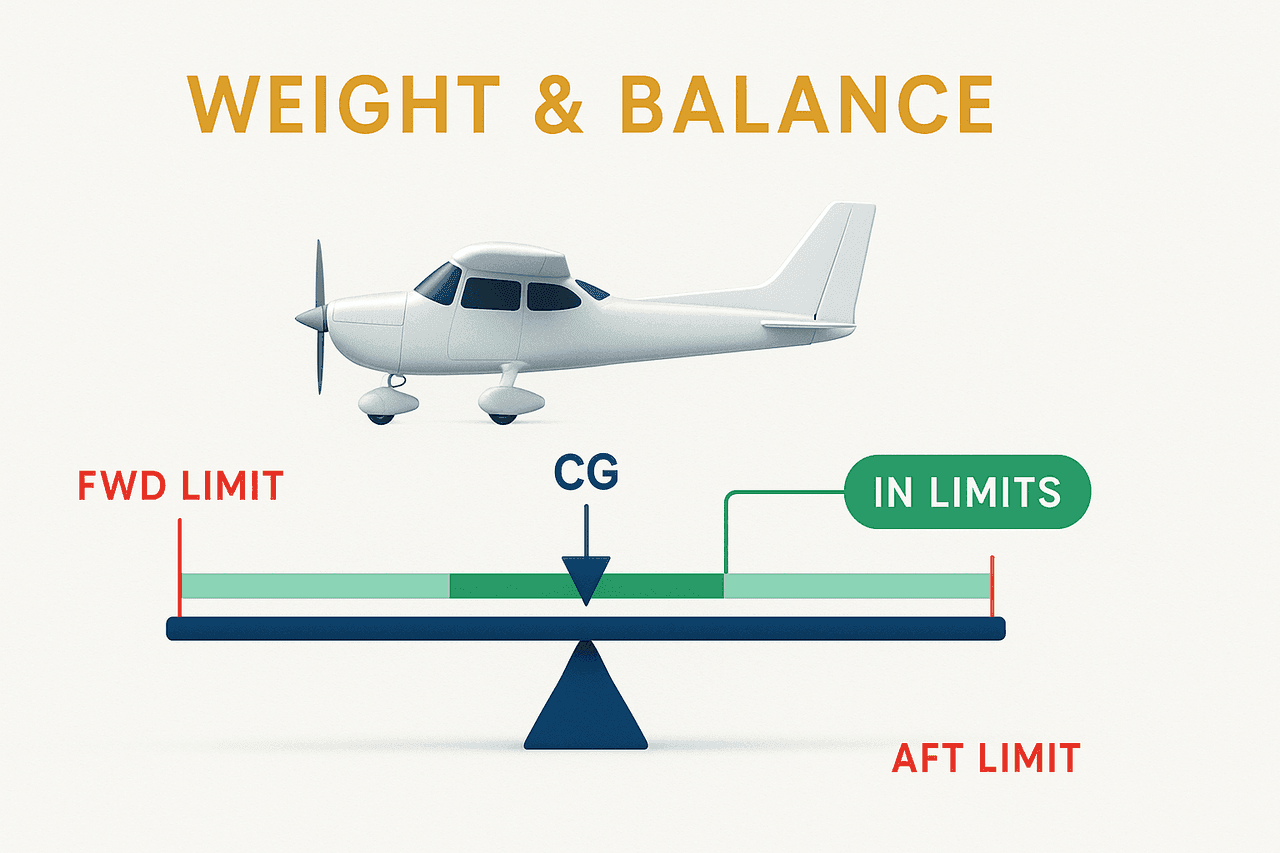
The Centre of Gravity (CG) must stay within the limits set in the manual, both the forward and the aft limits. The calculation uses moment = weight × arm from the reference point (datum). If the CG falls outside the limits, the aircraft becomes hard to control and dangerous. And do not forget to convert fuel volume into weight using specific gravity before calculating.
6.3 Flight Plan
- Field 7: call sign — Field 8: flight rules (V/I/Y/Z)
- Field 9: number and type of aircraft, with wake turbulence category — Field 10: equipment
- Field 13: departure aerodrome and time — Field 15: speed, level, and route
- Field 16: destination, time en route, and alternate aerodromes
Chapter summary
The core content is the correction factors for take-off and landing distances, keeping the Centre of Gravity within limits, and filling in the flight plan field by field.
Key terms
The aircraft's balance point of weight; it must stay within limits
Wind perpendicular to the runway
Used to convert fuel volume into weight
The form that declares the details of a flight
Weight × arm from the reference point (datum)
Frequently tested points
- Weight increase of 10% → take-off ×1.2, landing ×1.1
- Tailwind increases both take-off and landing distance (×1.2)
End-of-chapter quiz
24 questions